
Nearshore vs Offshore Development: The Overlap Math Nobody Publishes
The nearshore versus offshore argument is usually made by whichever side is writing. Here is the table of actual overlap hours, and the one question that decides which model fits.
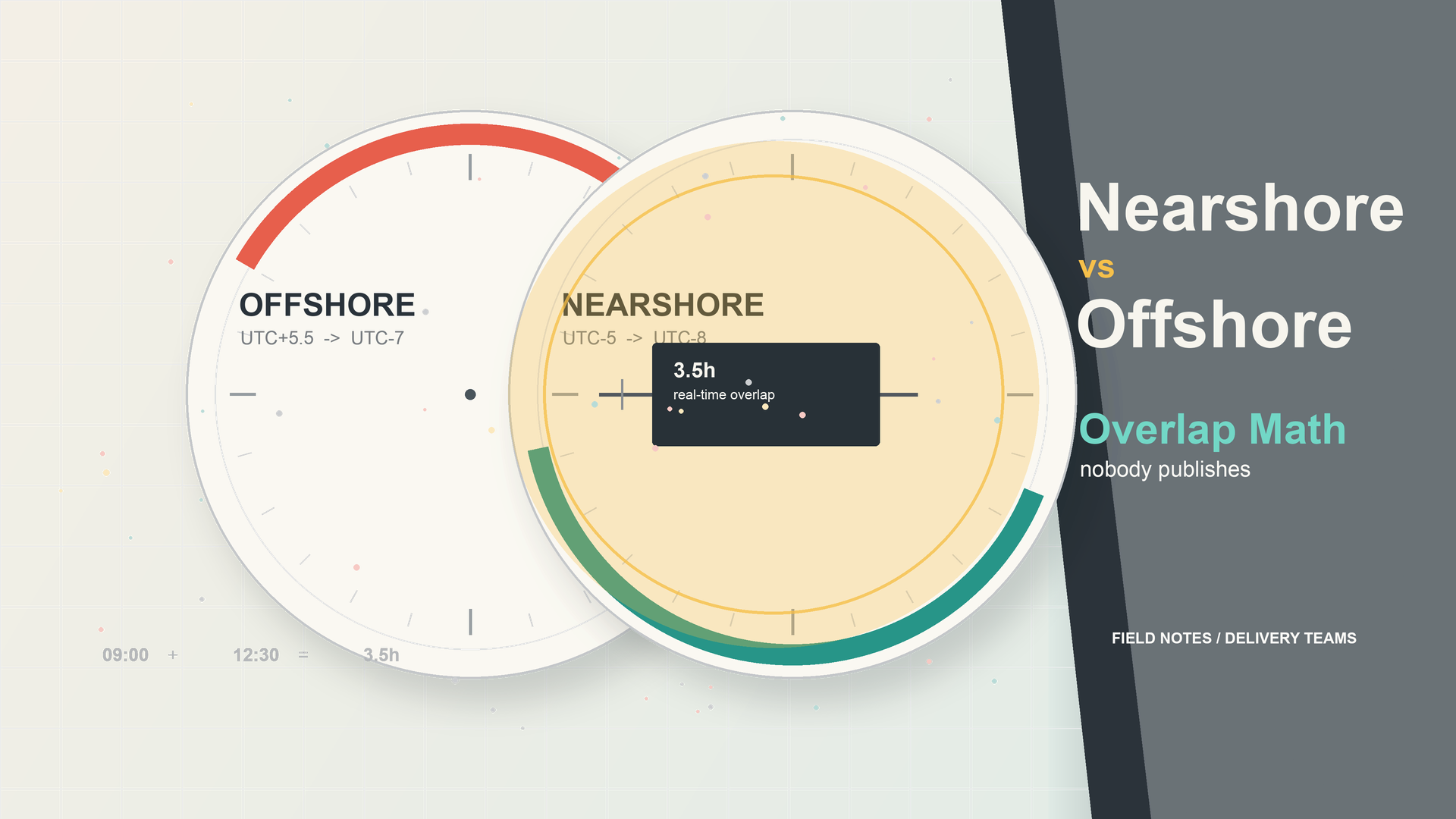
We are an offshore development company in Mumbai. What follows makes the case against us for roughly half of the people who read it, which is the point. The nearshore versus offshore argument is usually made by whichever side is writing, and the number that actually decides it is almost never printed.
Here is that number.
Hours of live overlap, by pairing
Both sides working 09:00 to 18:00 local, northern hemisphere summer:
| Your team is in | India | Poland / Ukraine | Colombia / Peru | Brazil / Argentina |
|---|---|---|---|---|
| US East Coast | 0h | 2.5h | 8h | 8h |
| US West Coast | 0h | 0h | 7h | 5h |
| UK | 4.5h | 7.5h | 3h | 5h |
| Australia (east) | 4.5h | 1.5h | 0h | 0h |
Read the first column twice. On standard business hours, an Indian team and a US team share no working time at all. Not a little. None. Every offshore vendor selling to the US is either shifting staff onto night hours or quietly running an async process and hoping you do not notice which.
The second thing to notice is that no column wins everywhere. Latin America is unbeatable for US clients and useless for Australian ones. Eastern Europe is the best answer for the UK and a poor one for the US West Coast. India is the only column that is workable for both the UK and Australia. There is no globally correct answer, only a correct answer for where you sit.
The rate gap is smaller than it looks, and it is not the deciding factor
Nearshore costs more per hour than offshore. That gap is real, and on a long engagement it is the difference between four engineers and six. But rate is a bad primary criterion, because the cost of a badly run project dwarfs the rate difference on a well run one. A team that is 30 percent cheaper and ships 50 percent slower is not cheaper.
The thing to optimise is not hours purchased. It is decisions per week.
The actual deciding question
Count how many times in a normal week your team needs a synchronous decision from someone on the other side. Not a status update. A decision: an ambiguous requirement, a design tradeoff, a production incident, a stakeholder changing their mind mid-sprint.
More than five a week. You need real overlap. Choose nearshore, or choose onshore. An offshore team will spend its life waiting on you, and you will spend yours writing clarifications at midnight. No amount of process fixes a structural four hour gap between question and answer.
One to five a week. Either model works, and the decision comes down to rate, available skills and how disciplined your written communication is. This is where most product teams actually sit, and it is where offshore usually wins on economics.
Fewer than one a week. Offshore is the obvious answer. Well specified work with clear acceptance criteria does not need a shared clock. You are paying a nearshore premium for a meeting you would not have taken.
Most teams guess high on this number. Before committing to a model, log it for two weeks. The result is often a third of what people expect, because a lot of what feels like a decision is actually a notification.
When nearshore is the right call
Be honest about these, because they are common:
- You are pre product-market fit and requirements change several times a week
- You have no written specification culture and are not going to build one for this project
- Your work is incident-heavy, with production issues needing same-hour response in your business day
- Your team is small enough that one senior person holds all the context in their head
- Regulatory or client contracts require staff in specific jurisdictions
In every one of those cases, hire nearshore. We will tell you the same thing on a call.
When offshore is the right call
- Your scope is stable enough to specify a sprint ahead
- You need a skill that is scarce and expensive in your market and abundant in ours
- You are in the UK, Europe, the Middle East, or Australia, where the overlap column is workable without night shifts
- You want more engineers for the same budget and can absorb a one day round trip on non-urgent questions
- You are building something long-lived where continuity of the same engineers matters more than instant response
If you go offshore, the protocol matters more than the vendor
The failure mode is never the code. It is the round trip. Teams that make offshore work do four things.
Book the overlap and treat it as sacred. Whatever hours you share, they are for decisions, not status. Status goes in writing. If your only shared 90 minutes gets eaten by a standup that reads out a board everyone can see, you have wasted the scarce resource.
Write acceptance criteria before work starts, not after it fails. The cost of ambiguity scales with the size of the time gap. Onshore, a bad ticket costs ten minutes. Offshore, it costs a day.
Batch your questions. An offshore team that gets one well-formed list of eight questions at the start of their day will answer all eight. The same eight arriving one at a time across your afternoon will get answered tomorrow.
Insist on the same people. Rotating engineers destroys the context that makes async work possible. Ask any vendor what their annual attrition on a given account is, and be suspicious of a vague answer.
What we actually do about the US column
Our standard day is 10:00 to 19:00 IST, which is fine for London, Dubai, Singapore and workable for Sydney. It is useless for the US, so we do not pretend otherwise. Our New York team runs 12:00 to 21:00 IST, which produces a 2.5 hour live window from 09:00 ET. For Pacific clients we run 14:00 to 23:00 IST and get roughly 90 minutes.
That is a real cost borne by real people working evenings, and it is why we are straightforward that a Bogota team will give a San Francisco client seven hours and we will give them ninety minutes. If those seven hours are what your project needs, buy them.
Where we work and what the overlap is in each city is on our locations page, and the work itself is on services. If you want to talk through which model fits, contact us and we will say so honestly, including when the answer is not us.
Queries raised before signature
Everything worth knowing about Nearshore vs Offshore Development: The Overlap Math Nobody Publishes.
01What is the difference between nearshore and offshore development?
Nearshore means hiring a team in a nearby country within a few hours of your time zone, such as a US company hiring in Colombia or Mexico. Offshore means a distant country with little or no overlap, such as a US company hiring in India. The distinction is about shared working hours, not distance in miles.
02How many hours of overlap do you get with an offshore team in India?
On standard 09:00 to 18:00 hours both sides, a US team gets zero. A UK team gets 4.5 hours, an Australian east coast team gets 4.5, Dubai gets 8.5 and Singapore 5.5. US overlap only exists if the offshore team works a shifted evening schedule.
03Is nearshore always better than offshore?
No. Nearshore is better for US clients who need frequent synchronous decisions. For UK, European, Middle Eastern and Australian clients, an Indian team gives more overlap than a Latin American one. The right answer depends on where you sit, not on which model is fashionable.
04How much cheaper is offshore than nearshore?
Offshore rates are meaningfully lower, though the exact gap depends on seniority and market. The more useful comparison is total cost of delivery rather than hourly rate, because rework caused by slow decision loops can erase the saving on a project that was a poor fit for the model.
05How do I know whether my project needs high overlap?
Count synchronous decisions per week for two weeks. More than five and you need nearshore or onshore. One to five and either model works. Fewer than one and offshore is clearly right. Most teams overestimate this number because they count notifications as decisions.
06Can an offshore team work my business hours?
Yes, by shifting staff to an evening or night schedule. It costs more and it should, because someone is giving up their evenings. Ask any vendor offering this how many people are on the shifted rota and how long they typically stay, because attrition on night shifts is the usual failure point.
07What is the biggest risk with offshore development?
Round trip latency on ambiguity. A poorly specified ticket costs minutes onshore and a full day offshore. The risk is almost never engineering capability. It is the accumulated cost of questions that wait.
08Does time zone overlap matter more than English fluency?
They solve different problems. Fluency determines the quality of a written handoff. Overlap determines how fast a spoken one happens. A team with excellent written English and low overlap works well on specified projects and badly on ambiguous ones.
09Is Eastern Europe nearshore or offshore?
It depends on where you are. For a UK or German client, Eastern Europe is nearshore with 7.5 hours of overlap. For a US West Coast client it is offshore with none. The label is relative to the buyer.
10What about hybrid models with a local lead and an offshore team?
They work well when the local lead genuinely owns decisions rather than relaying them. If the lead has to escalate every ambiguity to the offshore team anyway, you have added cost and a hop without removing the latency.
11How long does it take an offshore team to become productive?
Two to four weeks for a standard stack, longer for unusual legacy systems. The variable that matters most is the quality of the existing documentation and test coverage, not the team's location.
12Should I split work across nearshore and offshore teams?
Sometimes. A common split puts incident response and ambiguous discovery work nearshore, and specified delivery work offshore. It only works if the boundary between the two is clean. Splitting a single tightly coupled codebase across a seven hour gap usually costs more than it saves.
13Do you recommend nearshore to your own clients?
Yes, when it fits. If you are a US company pre product-market fit with requirements changing weekly, a Latin American team will serve you better than we will, and we would rather say that on the first call than six months in.
Sign off and we start
Tell us what you are trying to build. You will hear back from an engineer, not a sales desk.
- For
- e10 Infotech Private Limited
- Office
- Mumbai, Maharashtra
- Established
- 2011
- Direct line
- +91 86574 40720